
Quick answer
To test emergency exit lights, cut the normal power to them using the building’s test switch or by isolating the lighting circuit, then check that every emergency light and exit sign switches to battery and stays lit for at least 90 minutes. Record the results in the log book and repair or replace any fitting that fails. In Australia, this full discharge test is done every six months under AS/NZS 2293.2, usually by a fire safety technician or electrician. Pressing a fitting’s test button is a handy spot check, but it won’t tell you whether the battery can last the full 90 minutes.
Emergency exit lights are easy to forget about. They sit quietly above doors and along corridors for months, and the only time anyone really needs them is when the power goes out and people have to find their way out. A light with a flat battery looks just like a working one until that moment, which is why regular testing matters.
In this guide we walk through how emergency exit lights are tested in Australia, what you can safely check yourself and what to do when a fitting fails. If you’d rather hand it over to a professional, our emergency and exit light testing service covers every fitting in your building.
Emergency Lights vs Exit Signs: What You’re Testing
“Emergency exit lights” is a catch-all term for two kinds of fittings. Both have a battery that takes over when the normal power fails, and both are tested in the same way:
- Emergency lights: ceiling or wall fittings that light up corridors, stairs and open areas so people can see where they’re walking. Some only come on in a blackout, while others double as everyday lighting.
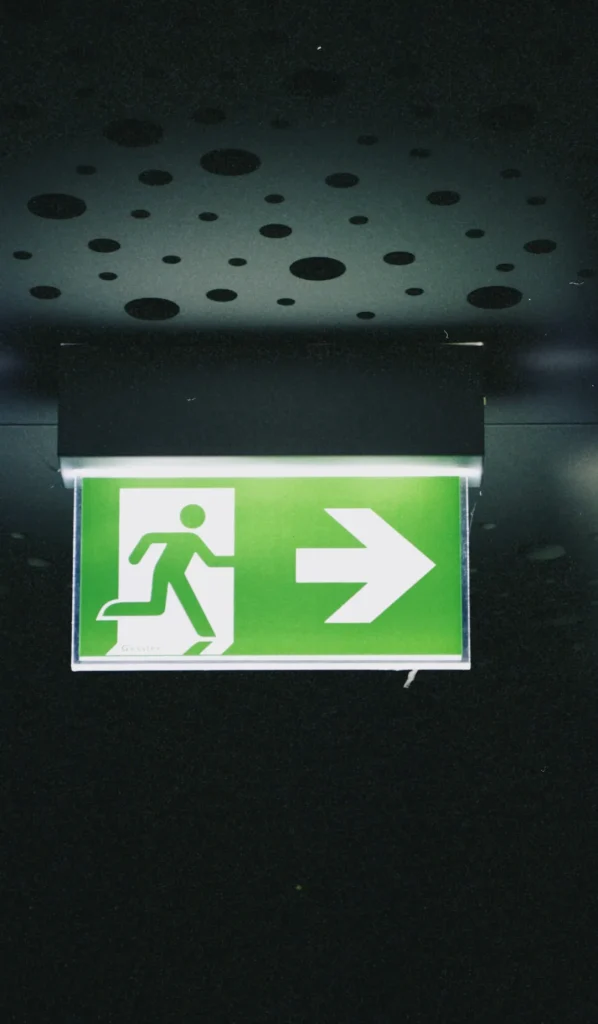
- Exit signs: illuminated signs that point the way to the nearest exit, usually with a green running figure and an arrow.
In Australia, these fittings are designed and installed to AS/NZS 2293.1, and AS/NZS 2293.2 sets out how they’re tested and maintained. AS 1851, the standard for routine servicing of fire protection systems, points to AS/NZS 2293.2 for emergency lighting.
How Often Should Emergency Exit Lights Be Tested?
Testing happens at a few different levels across the year:
Your building’s fire safety schedule lists the standard its emergency lighting has to be maintained to, so check it if you’re not sure. Most buildings follow AS/NZS 2293.2, although some older schedules still refer to an earlier edition.
How to Test Emergency Exit Lights, Step by Step
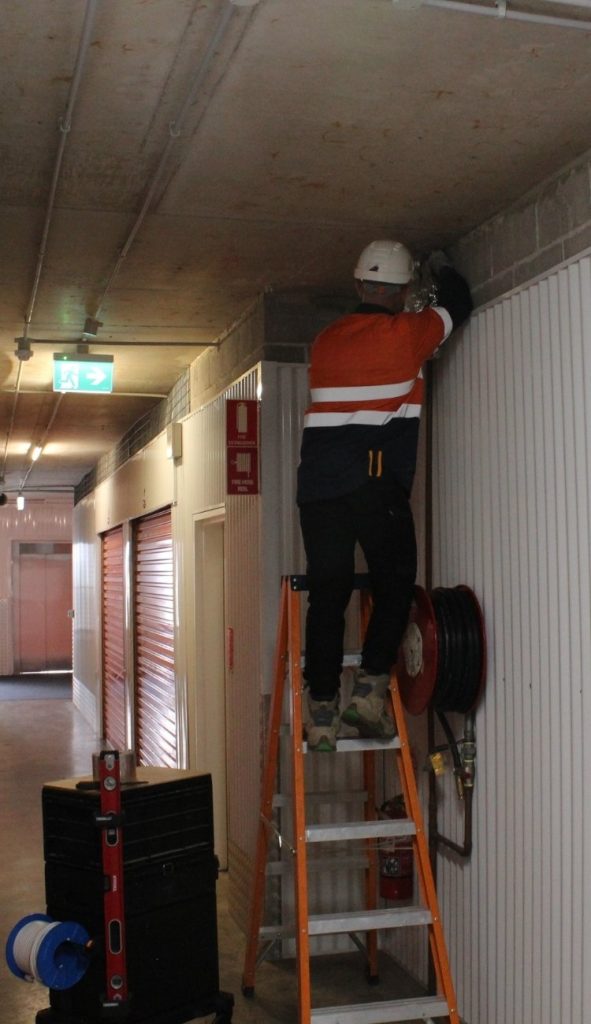
This is the full six-monthly discharge test. Because it involves cutting power to lighting circuits, it should be carried out by a qualified technician, but it helps to know what’s involved:
- Make sure the batteries are charged. Each fitting’s charge indicator should be on. New or recently reconnected fittings generally need around 24 hours on mains power before they’re tested.
- Pick the right time and let people know. After the test, the batteries need time to recharge, so the building has less backup for a while. Tests are usually booked for quiet periods, and occupants are told beforehand.
- Locate every fitting. Use the log book or a fitting register to find every emergency light and exit sign, including the ones in stairwells, plant rooms and car parks.
- Cut the normal power. The technician uses the test switch or test system built into the installation, or isolates the circuits that feed the fittings, so they all drop over to battery power.
- Check every fitting straight away. Walk the building and confirm that each emergency light has come on and each exit sign is lit.
- Leave them running for at least 90 minutes. Then walk the building again. Every fitting should still be lit, so note any that have dimmed noticeably, started flickering or gone out.
- Restore power and confirm charging. Switch the normal supply back on and check that each fitting’s charge indicator lights up again.
- Record the results and fix failures. Write the results in the log book, along with the location of any fitting that failed. Repair or replace those fittings, then test them again.
Using the Test Button for a Quick Check
Many emergency lights and exit signs have a small test button, often next to the charge indicator. Pressing it briefly makes the fitting behave as if the power has failed, so you can see whether the lamp lights up on battery.
It’s a useful spot check between services, especially if a fitting looks dim or its charge indicator is off. But a press of a few seconds only proves the battery has some charge. It doesn’t show whether the fitting can stay lit for 90 minutes, so it can’t replace the six-monthly discharge test.
Charge indicator off? If a fitting’s charge light is out while the power is on, its battery may not be charging at all. Report it straight away rather than waiting for the next scheduled test.
What to Check on Exit Signs
Exit signs need a little extra attention, because people have to be able to read them as well as see them. On each sign, check that:
- it’s lit, both on mains power and during the battery test
- the running figure and arrow are clear and point the right way to the exit
- it can be seen from along the path of travel, without shelving, banners or new walls in the way
- the face and diffuser are clean, intact and not faded or yellowed
- it’s securely fixed, with no loose or hanging parts
- its charge indicator is on
What Happens If an Emergency Light Fails the Test?
A failed fitting doesn’t mean the whole system is faulty. Usually, one of these is to blame:
- Worn-out battery: batteries lose capacity as they age, so an older fitting may light up but go out before the 90 minutes are up.
- Failed lamp or LED driver: the battery is fine, but the light itself won’t come on.
- Charging fault: a faulty charger or power supply means the battery never fully charges.
- Wiring problem: a fitting connected to the wrong supply may not notice the power failure, or may drain its battery whenever the normal lights are switched off. Our guide on whether emergency lights need their own circuit explains how they should be wired.
Faulty fittings should be repaired or replaced, tested again and the outcome recorded in the log book. Our technicians replace batteries, lamps and complete fittings on existing circuits, while new wiring is handled by a licensed electrician.
Self-Testing and Monitored Emergency Lighting
Some buildings have self-testing fittings, or a monitored system that runs the discharge test automatically and stores the results. These systems save time, but they still need looking after. A technician should review the test records, follow up any faults the system reports and carry out the yearly cleaning and checks in person.
Who Should Test Emergency Exit Lights?
Building owners and managers can do the quick visual checks and test-button spot checks themselves. The six-monthly discharge test is different. It involves cutting power to lighting circuits and keeping accurate records, so it should be done by a qualified fire safety technician or licensed electrician working to AS/NZS 2293.2.
In NSW, building owners also have to keep each essential fire safety measure maintained, and an Annual Fire Safety Statement confirms each year that they’ve been assessed. Our guide on whether annual fire inspections are required explains how the statement works, and our fire inspection services can cover your emergency lighting alongside the rest of your fire safety equipment.
Frequently Asked Questions
How long should emergency exit lights stay on during a test?
At least 90 minutes on battery power during the six-monthly discharge test. A fitting that dims noticeably or goes out before then has failed and needs to be repaired or replaced.
Can I test emergency exit lights myself?
You can check that charge indicators are on and signs are lit and visible, and press the test button for a quick check. The formal six-monthly discharge test should be left to a qualified technician, because it involves isolating lighting circuits and keeping compliant records.
How often do exit signs need to be tested?
Exit signs are tested along with the emergency lights: a discharge test every six months, plus a yearly clean and check. Quick visual checks in between help you spot problems early.
What should be recorded in the emergency lighting log book?
The date of each test, who carried it out, the results, the location of any fittings that failed and what was done to fix them. In NSW, these records support your Annual Fire Safety Statement.
Do LED exit signs still need testing?
Yes. LED fittings use less power and last longer, but they still rely on a battery when the power fails, and batteries wear out. They need the same six-monthly discharge test as any other fitting.
So, how do you test emergency exit lights? Cut the normal power, make sure every fitting stays lit on battery for at least 90 minutes, record the results and fix anything that fails, every six months. If you’d like it taken care of, the team at VQS Fire can test the emergency lights and exit signs across your building.