Quick answer
In most buildings, no. Self-contained emergency lights and exit signs are usually connected to the same lighting circuit as the normal lights in the area they cover, using an unswitched active. That way, if the lighting circuit fails, the emergency lights notice straight away and switch to battery. Central battery systems are the exception: they run on their own dedicated wiring from a central battery. Either way, the installation must follow AS/NZS 2293.1 and the wiring rules, and be done by a licensed electrician.
It sounds logical to give emergency lights their own circuit. They are safety equipment, so keeping them separate from everything else seems like the careful choice. In practice, it can do the opposite. An emergency light only helps if it comes on when the normal lights around it go out, and how it is wired decides whether it can tell that has happened.
In this guide we explain how emergency lights are normally wired in Australian buildings, when a separate circuit does make sense, the wiring problems that show up during testing, and who should do the work. If your building’s lights are due for their six-monthly check, our emergency lighting testing team can help.
Do Emergency Lights Need to Be on Their Own Circuit?
For the most common type of emergency lighting, the answer is no, and putting them on a separate circuit can create a problem.
Most Australian buildings use self-contained, or single-point, emergency lights. Each fitting has its own battery, charger and control gear built in. The fitting is powered from the mains to keep the battery charged. When it senses the mains supply has gone, it switches to battery and lights up the escape route.
Here is the catch. A self-contained fitting can only sense a failure on the circuit it is connected to. If it shares the lighting circuit for that area, a tripped breaker or blown fuse on that circuit puts the normal lights out and switches the emergency light on at the same time, which is exactly what you want.
If it sits on a separate circuit instead, the lights in the room can fail while the emergency light keeps receiving power. It thinks everything is fine, stays off, and people are left in the dark.
- Shares the circuit with the lights it backs up
- A fault on that circuit triggers the emergency light
- No extra sensing equipment needed
- The usual setup for self-contained fittings
- Powered independently of the room’s lights
- A lighting fault may not trigger the emergency light
- Needs circuit sensing to work properly
- Used with central battery and some monitored systems
What an “Unswitched Active” Means
You will often hear that emergency lights need an unswitched active. In simple terms, it means the fitting gets power from the lighting circuit before the light switch, so it stays powered whether the room lights are on or off.
This matters because the emergency light uses that supply to keep its battery charged and to watch for a power failure. If it were wired after the light switch, every time someone turned the lights off at night the fitting would think the power had failed. It would come on, drain its battery and might be flat when a real emergency happens.
Maintained or non-maintained? Non-maintained fittings only light up when the power fails. Maintained fittings, like most exit signs, stay lit all the time and keep running on battery when the power goes. Both still need a permanent supply so the battery stays charged.
When Can Emergency Lights Be on a Separate Circuit?
There are good reasons to use dedicated emergency lighting circuits, as long as the system has another way of knowing when the normal lighting fails. The common setups are:
- Central battery systems: one large battery bank powers all the emergency fittings over dedicated wiring. The central system monitors the normal supply and switches the fittings on when it fails.
- Circuit sensing: the emergency lights are on their own circuit, and relays or sensing devices watch the normal lighting circuits. If a lighting circuit fails, the emergency lights in that area are told to switch on.
- Monitored and addressable systems: larger buildings may use systems that report the status of every fitting to a central controller, which also handles sensing and testing.
These designs are common in large commercial buildings, hospitals and high-rise towers, where a separate circuit makes testing and maintenance easier to manage across hundreds of fittings. They are designed by an electrical engineer or contractor, not added on an ad hoc basis.
Single-Point vs Central Battery Emergency Lighting
The type of system in your building decides how its emergency lights should be wired.
| Single-point (self-contained) | Central battery | |
|---|---|---|
| Where the battery is | Inside each fitting | In one central cabinet |
| How it’s wired | Usually from the area’s lighting circuit, unswitched active | Dedicated circuits from the central system |
| How it detects a failure | Senses loss of power on its own circuit | The central system monitors the normal supply |
| Typical buildings | Offices, shops, strata, warehouses | Large commercial, health and high-rise |
| Battery replacement | Fitting by fitting | One battery bank |
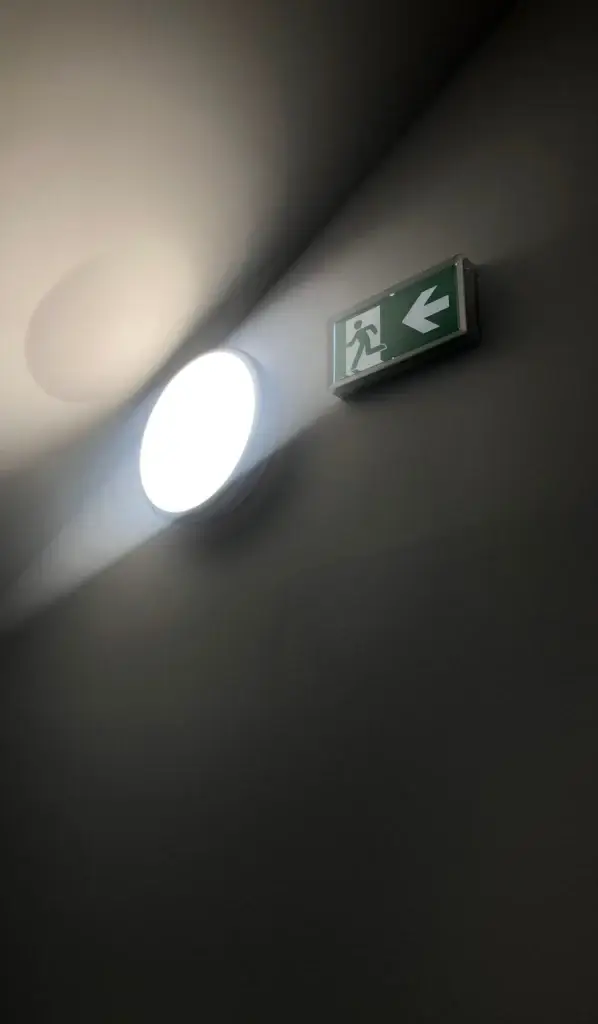
Wiring Problems That Show Up During Testing
Many wiring issues stay hidden until someone tests the lights properly. These are some of the most common problems found during routine emergency lighting checks:
- Fittings wired to a switched supply, so batteries drain every night and fail their discharge test.
- Fittings on a different circuit from the lights they are meant to back up, often after a fit-out or renovation.
- Extra fittings added without updating records, so nobody knows which circuit they are on or that they need testing.
- No easy way to test, such as missing or unlabelled test switches, making every test slower and more disruptive.
- Old batteries and failed lamps that look fine with the power on but won’t last the required time on battery.
Fit-outs are a common cause. When walls move and new lighting goes in, emergency fittings can end up connected to whatever circuit was handy. Testing after any fit-out is the best way to catch it.
How Emergency Lights Are Tested
Emergency lighting is designed and installed to AS/NZS 2293.1 and maintained to AS/NZS 2293.2, the standard that AS 1851 refers to for emergency lighting. The main routine is a six-monthly discharge test:
- The normal supply is interrupted using the test switch or test system, so every fitting switches to battery.
- The fittings run on battery for at least 90 minutes while a technician checks each one is lit.
- Failures are noted, including fittings that dim, flicker or go out early.
- Faulty batteries, lamps or fittings are replaced and retested.
- Results are recorded in the log book, supporting the building’s Annual Fire Safety Statement.
A discharge test is also the best check that the wiring is right. A fitting on a switched supply or the wrong circuit usually shows itself by failing early. Our six-monthly emergency and exit light testing covers every fitting on site, and can be booked alongside your other scheduled fire safety inspections.
Who Can Install or Change Emergency Light Circuits?
Running new circuits, moving fittings to a different circuit or installing a new emergency lighting system is electrical work. In NSW it must be done by a licensed electrician, and the design must meet AS/NZS 2293.1 and AS/NZS 3000.
Day-to-day maintenance is different. Testing the lights, replacing batteries and lamps, and swapping a failed fitting on its existing circuit are part of routine servicing. At VQS Fire, our technicians test, repair and replace emergency lights and exit signs on existing circuits, so most faults are fixed without bringing in another contractor. Where new cabling or circuits are needed, that work is for a licensed electrician.
A quick checklist for building owners and strata managers:
- Make sure emergency lights are tested every six months and the log book is up to date.
- Ask for a test after any fit-out or electrical work that touched the lighting.
- Keep records of how your system is wired, especially in larger buildings.
- Fix failed fittings quickly, as they are a common item on an Annual Fire Safety Statement.
Strata buildings often have emergency lights in stairwells, car parks and corridors that are easy to forget. Our residential and strata fire protection services cover these common areas along with fire doors, alarms and equipment.
Frequently Asked Questions
Can emergency lights be on the same circuit as normal lights?
Yes. For self-contained fittings, that is the usual setup. Sharing the lighting circuit means the emergency light switches on when that circuit fails.
Do emergency lights need an unswitched active?
Yes. They need a permanent supply so the battery stays charged and the fitting doesn’t treat switching the lights off as a power failure.
Do exit signs need their own circuit?
Not usually. Self-contained exit signs are wired the same way as emergency lights, from the lighting circuit for the area. In central battery systems, they run on the system’s dedicated circuits.
How long should emergency lights stay on during a power failure?
At least 90 minutes. That is the duration checked during the six-monthly discharge test.
Can I install emergency lights myself?
No. Installing or rewiring emergency lights is electrical work and must be done by a licensed electrician. Testing and replacing failed fittings on existing circuits can be done by a fire services technician.
Emergency lights don’t usually need their own circuit. In most buildings they work best on the same lighting circuit as the area they protect, with an unswitched active to keep the battery charged. If you are unsure how your lights are wired, or they are due for testing, the team at VQS Fire can check every fitting and fix any that fail.